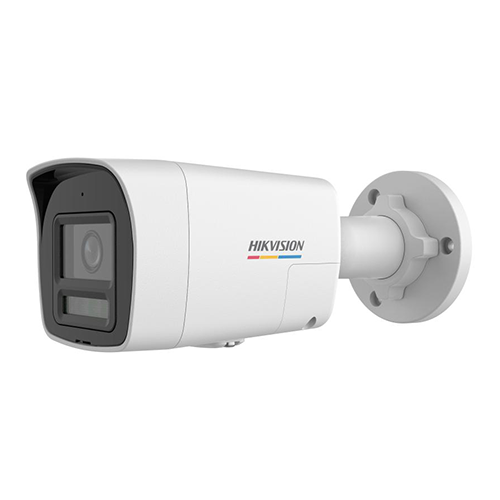

Outdoor positions — gates, yards, perimeters, car parks — run in sun, dust and long night hours. The choice most often made wrong is the first: a resolution figure gets picked before anyone decides what the position has to prove.
How to choose
- What the position must prove. Deterrence, coverage, or identification of a face or a plate — three different cameras. A bullet everyone can see is deterrence; identification is a narrow view of one approach at a known distance, not a bigger sensor.
- Fixed lens or motorised varifocal. A fixed lens locks the field of view at the order, so the survey has to be right. Motorised costs more and adjusts from the ground — price that against a second trip to the mount. On a pole or a high parapet, one return visit settles it.
- Colour at night, or not. A lighting decision as much as a camera one. White supplement light is visible to whoever stands in it: welcome on a yard, a complaint facing a neighbour’s balcony. Walk the position after dark first.
- Bracket, cable entry and gland. The part of an outdoor job that actually fails. Wall, parapet and pole take different brackets, usually ordered separately, and the entry has to be sealed and shaded.
All genuine Hikvision, with the official one-year manufacturer warranty and delivery to every Egyptian governorate. Send the site, the distances and the recorder and our technical team will pick the model and brackets with you on 16454.
Where these have gone in
Outdoor and industrial positions are most of what we specify on project work. At Khalda Petroleum that meant over 1,000 smart surveillance units and more than 40 globally certified explosion-proof cameras across an industrial-grade system. At Sidi Kerir Petrochemicals (SIDPEC) it meant explosion-proof CCTV in certified ATEX/IECEx enclosures tied into centralised monitoring, with SYSTEL. See the projects we have delivered.